The Dangers of Co-Signing a Loan: What You Need to Know
Picture this: A friend or family member you care about asks “Could you just co-sign this for me? It’s just a formality. I’ll handle all the payments; you won’t even know it’s there.”
It feels like a noble act of support. In your mind, you’re being a mentor or a safety net. But in the world of finance, there is no such thing as a “formality.” When you pick up that pen, you aren’t just vouching for someone’s character; you are legally tethering your financial future to theirs.
Despite the best of intentions, co-signing is one of the most dangerous financial moves you can make. Before you sign on the dotted line, let’s peel back the curtain on what you’re actually agreeing to.
Risk #1: Full Financial Liability if the Borrower Defaults
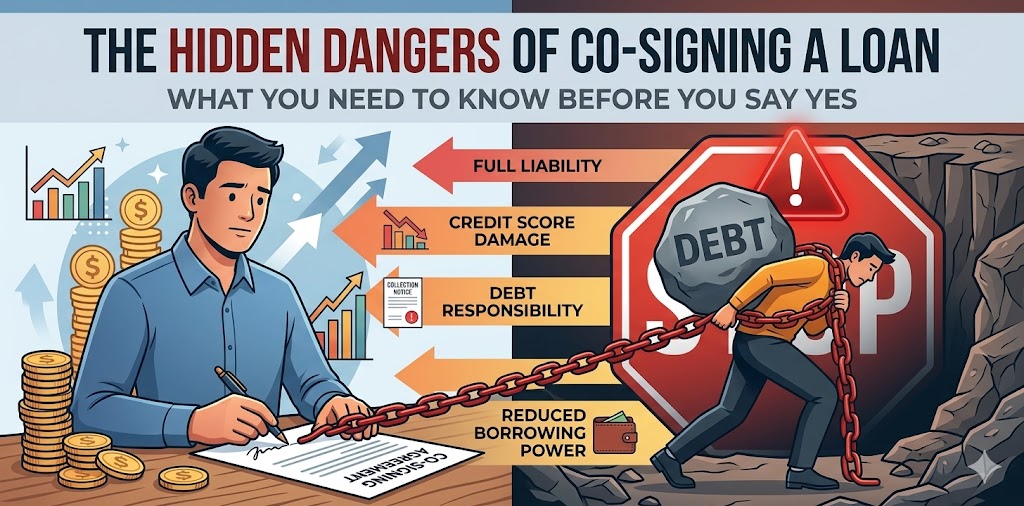
When you become a guarantor or co-signer for someone’s loan, you’re not just supporting them; you’re becoming equally responsible for the entire debt. Lenders don’t view co-signing as a soft safety net. They view you as a backup plan. If the primary borrower misses payments or stops paying altogether, the lender will come after you for the full amount, including accumulated interest and potentially late fees and collection costs.
This liability is unconditional. The lender doesn’t have to try collecting from the primary borrower first. They can skip that step entirely and pursue you immediately. This principle is called “full recourse,” and it’s the default in most co-signing arrangements.
Consider, if someone borrows ₹25 lakhs for a home loan and you’re their guarantor and they default, the bank can directly demand the entire ₹25 lakhs from you, the full amount, plus accumulated interest, plus penalties.
Risk #2: Your Credit Score Takes a Serious Hit
In India, your CIBIL score (maintained by TransUnion CIBIL, Equifax, Experian, and CRIF) is one of your most valuable financial assets. It determines what interest rates you’ll get on future loans, whether you’ll be approved for mortgages or business loans.
Co-signing a loan directly damages this asset—in two ways.
First, the loan appears on your credit report as an account you’re responsible for. If the borrower makes late payments, that delay is reported to CIBIL under your name. Your score drops. If the borrower defaults, your score drops even further. This damage is real and persistent.
Second, the loan counts against your Debt-to-Income ratio. When you apply for your next loan, banks look at how much debt you’re already servicing. If you’re guarantor on a ₹50 lakh loan, even if the borrower is paying perfectly, that ₹50 lakh counts against you. If you want to buy your own home or start your own business, the bank will say: “Your debt-to-income ratio is too high. We can’t give you more credit.”
Unlike some financial mistakes that fade with time, co-signing damage is persistent. Under Indian credit reporting rules, a late payment stays on your credit report for 7 years. If the account goes to collection or if the bank pursues legal action, the negative mark can remain even longer. If the borrower pays on time, the damage is limited to your increased debt-to-income ratio. But if they miss payments, you’re looking at 7 years of recovery time.
Risk #3: Relationship Strain and Emotional Consequences
In Indian culture, family and close friends are expected to help each other during financial hardship. But financial stress is one of the leading causes of relationship breakdown. When you co-sign a loan and the primary borrower struggles to make payments, you’re not just dealing with a financial problem—you’re dealing with a relational crisis.
The dynamics typically unfold like this: The borrower misses a payment. The bank contacts you. You call the borrower, frustrated and concerned. The borrower becomes defensive, embarrassed, or blames external circumstances. You feel resentful that you’re being dragged into their financial problems. The borrower feels judged or unsupported. What started as an act of support transforms into a source of conflict and hurt.
In many Indian families, silence about financial problems is common. You might not know the borrower is struggling until the bank contacts you about collection. By that point, trust has already eroded from your perspective—they didn’t tell you they were in trouble. From their perspective, they might feel you’d judge them or that they still had time to recover.
Risk #4: Loss of Financial Flexibility and Independence
Co-signing reduces your financial flexibility in ways that extend far beyond the loan period. When the loan is active, you cannot take on new major debt without including the guaranteed loan in your calculation. This affects your ability to:
- Buy a house or refinance an existing home loan (perhaps the most important investment decision in India)
- Take a business loan if you are an entrepreneur
- Take an education loan for your children (which is common in India)
- Use debt as collateral in emergency situations
Imagine you want to buy a house in 3 years. You co-sign a 10-year loan today. During your home-buying window, you will still be responsible for that loan and it will affect how much you can borrow and at what interest rate. You might buy a smaller house or miss the opportunity entirely.
Risk #5: Limited Control Over the Loan
A frustrating reality of co-signing is this: you are legally responsible for the loan, but you have no authority over how the original borrower uses the money or manages the account. The bank typically communicates with the original borrower, not with you. You don’t automatically receive payment statements or default notices.
This creates a dangerous information gap. You won’t know the borrower is in trouble until the bank calls you, by then the situation has seriously deteriorated and your options are limited.
Practically speaking, co-signing means you have no real protection. You are responsible, but helpless.
Actionable Alternatives to Co-Signing
If you care about someone and want to support them financially, becoming a loan guarantor is often not the best path. Consider these alternatives:
- Provide a direct personal loan: If you have the financial capacity, offer a direct personal loan from your own funds. Use a written agreement (even a simple one) that specifies the loan amount, repayment schedule, and interest rate (even if it’s zero). This avoids involving a third party and gives you more control over the terms.
- Guarantee strategically (if you must): If you consider co-signing necessary, reduce your risk:
- Only guarantee loans you can repay if needed
- Ask for a “Co-signer Release” clause (available on some loans if the borrower makes a set number of on-time payments)
- Arrange for the lender to communicate with both parties, so you’re informed of any problems
- Have an open conversation with the borrower about what happens if they cannot pay
- Set boundaries: If asked to co-sign, you have the right to say “no.” A simple “I’m not in a position to take on that obligation” is sufficient. You don’t need to justify your decision. In Indian culture, saying “no” can be difficult, but your financial security is as important as helping someone else.
Questions to Ask Before Co-Signing
If you’re still considering co-signing despite these risks, use this checklist to pressure-test your decision:
- Can I pay off this entire loan myself if needed? If the answer is no, you should not co-sign.
- Do I fully understand all the loan terms? Read every word of the loan agreement. Know the interest rate, monthly payment, total amount you’re responsible for, and timeline. Are there hidden fees? Is there a prepayment penalty?
- Have I discussed the consequences with the borrower? Do they understand that if they default, you are fully responsible? Do they know what will happen to your relationship if they miss payments?
- Why do they need a guarantor? If they have weak credit or no credit history, are there other ways to address this? Can they build their credit by taking a smaller loan for the first 6-12 months?
- Is this based on emotion or evidence? Are you co-signing because you love this person, or because you truly believe they will repay the loan? These are different things.
- What’s my plan if they default? Can you cover that amount? How will this affect your savings? Can you discuss this with your family?
- Can I get this in writing? Even if it’s with a family member, have a written agreement (even very simple) that clarifies the terms. This ensures transparency.
Conclusion
Co-signing a loan may seem like a simple act of support but the financial and relational consequences are anything but simple. You could be responsible for ₹20 lakhs or more. Your CIBIL score could suffer for years. A valuable relationship could be permanently damaged. Your ability to achieve your own financial goals could be compromised.
In India, where family and “family-like” relationships are so important, the cultural expectation of co-signing is strong. But wisely saying “no” can be the most loving thing to do.
The most important decision you can make is an informed decision. Understand that co-signing means full financial responsibility, not partial responsibility. Recognize that your CIBIL score and financial flexibility are at stake. Acknowledge the relational risks and accept the possibility that financial stress will test even strong bonds.
If you still decide to co-sign, do it with your eyes open. Use a co-signer release clause if available. Keep communication open with the borrower. Have a written agreement. And most importantly, only guarantee an amount you can cover yourself.
But if you’re uncertain, if you feel pressured, if you’re worried about saying “no,” if the amount seems large, trust that intuition. Protecting your own financial health is the best thing you can do for someone you love. In the long run, setting boundaries is far more helpful than providing uncertain support.
Your CIBIL score, your financial independence and your relationships are too valuable; more than anything that only gives you liability.