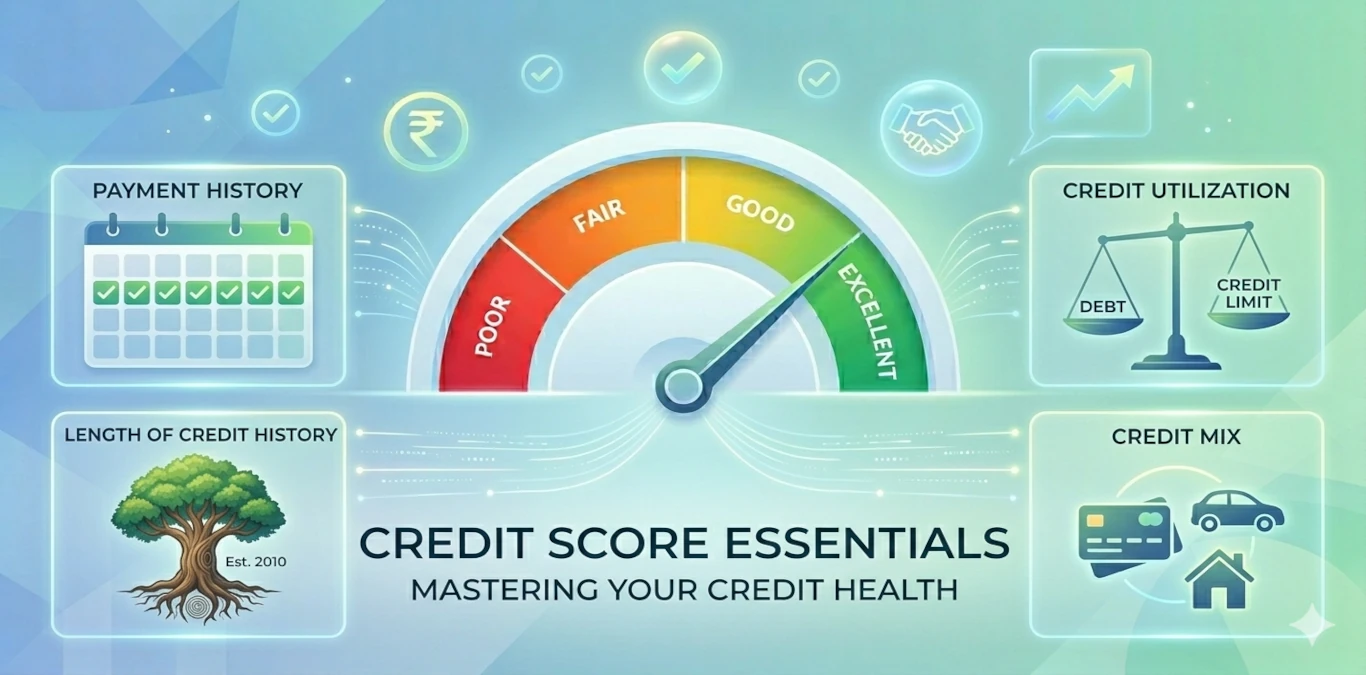
Credit Score Essentials: Mastering Your Credit Health
When you walk into a doctor’s clinic for a routine check-up, one of the first things measured is your blood pressure. A reading of 120/80 is widely considered the healthy benchmark. If the numbers fall too far outside that range, it signals that something needs attention, perhaps immediately.
In the Indian lending ecosystem, your credit score plays a very similar role. It is your financial “blood pressure.” Instead of being measured on a narrow medical scale, your financial health is expressed as a three-digit number ranging from 300 to 900.
A credit score feels mysterious. It’s just a three-digit number. How much power can it really have?
The truth is that number can influence your ability to borrow, the interest rates you are offered and even how confident financial institutions feel about doing business with you. Understanding your credit score is not about becoming a financial expert overnight. It’s about learning the fundamentals so you can make smarter choices and avoid costly mistakes.
Understanding Credit Scores: The Basics
A credit score is a mathematical summary of your credit history. It is a number, typically ranging from 300 to 900 (though scales can vary by country and credit bureau), that represents your creditworthiness. A score at the higher end of this range signals stability, discipline and lower risk. A score at the lower end raises red flags for lenders. And just like blood pressure, you may not feel anything is wrong until you apply for a loan and face rejection or receive approval with unfavourable terms.
When you ask a bank for a loan, they don’t know you personally. They don’t know that you’re a hardworking professional or that you never miss a deadline at work. They need a standardized way to predict one thing: “If we give this person money, what is the likelihood they will pay us back on time?”
The credit score is the answer to that question.
The Role of Credit Bureaus
Credit scores don’t just appear out of thin air. They are calculated by credit bureaus, agencies that collect data about your borrowing and repayment behavior from various sources like banks, credit card companies and even utility providers.
In India, for example, major bureaus like CIBIL issued by TransUnion CIBIL, Experian and Equifax gather this data to create your credit report. If your credit score is your “financial blood pressure,” then your credit report is your comprehensive diagnostic history.
Why It Matters
A high credit score is like a VIP pass in the financial world. It signals to lenders that you are a “low-risk” borrower. This trust translates into tangible benefits:
- Faster Loan Approvals: Lenders are more likely to say “yes” quickly.
- Lower Interest Rates: A high score can save you thousands (or even lakhs) of rupees over the life of a loan.
- Higher Loan Amounts: Banks may be willing to lend you more because they trust your repayment capacity.
- Better Credit Card Offers: Access to cards with rewards, travel perks and lower fees.
Factors Influencing Your Credit Score
Many people view their credit score as a mysterious number that fluctuates randomly. In reality, it is calculated based on specific, weighted categories. While the exact formulas are proprietary secrets of the credit bureaus, we generally know what moves the needle.
1. Payment History (The Heavyweight)
This is one of the most important factors. Do you pay your EMIs and credit card bills on time?
Late payments, missed payments or loan defaults negatively impact your score.
Lenders want to see a consistent track record of on-time payments. Even one missed payment or a delay of 30 days can cause a noticeable dip in your score.
Consistent on-time payments, month after month, build trust in your profile.
2. Credit Utilization Ratio
This is a fancy term for how much of your available credit you are actually using.
For example, if you have a credit card limit of ₹1,00,000 and you consistently carry a balance of ₹90,000, your utilization is 90%. High utilization suggests that you are more dependent on credit and may lower your score.
- The Golden Rule: Aim to keep your utilization below 30%. High utilization suggests you may be overextended and reliant on credit to get by.
3. Credit History Length
The longer you’ve successfully managed credit, the better. This is why it’s often advised not to close your oldest credit card accounts. A long history provides more data points for the bureau to prove you are a reliable borrower over the long haul.
4. Credit Mix
Lenders like to see that you can handle different types of credit responsibly. This includes:
- Unsecured Credit: Credit cards, personal loans.
- Secured Credit: Home loans, car loans.
A diversified credit profile demonstrates that you can handle different types of credit responsibly.
5. New Credit Inquiries
Every time you apply for a new loan or credit card, the lender performs a “hard inquiry.” Too many inquiries in a short period can make you look “credit hungry” or desperate for funds, which can temporarily lower your score.
It is wise to apply for credit only when necessary.
Practical Steps to Strengthen Your Credit
If your credit score isn’t exactly where you’d like it to be, take a deep breath. There’s no need to panic. A credit score isn’t permanent; it’s simply a reflection of your recent financial behavior. And the best part?
You have the power to improve it with consistent, smart habits.
Let’s walk through some simple, effective steps you can start today.
1. Pay All Dues on Time
This is your golden rule. Whether it’s a credit card bill or an EMI, paying on time sends a strong signal that you’re reliable. Even a single missed payment can leave a mark, so set reminders or automate payments whenever possible. Think of timely payments as the foundation of your credit health — strong and steady.
2. Monitor Your Credit Report
Make it a habit to check your credit report periodically. Look out for errors, unfamiliar accounts or incorrect late payment entries. Mistakes do happen and spotting them early allows you to raise a dispute with the credit bureau and get them corrected. Staying informed keeps you in control.
3. Keep Credit Utilization Low
Try not to max out your credit cards. Using a smaller portion of your available limit shows that you’re managing credit responsibly. If needed, you can spread expenses across cards or request a higher limit but only if your spending stays disciplined. The goal is control, not expansion.
4. Avoid Frequent Loan Applications
Applying for multiple loans in a short span can make lenders nervous. It says, “I’m desperate.” Instead, do your research first. Understand eligibility criteria and apply strategically. Fewer applications, better planning, that’s the smart way forward.
5. Don’t Rush to Close Old Accounts
Older credit accounts actually help you. They build the length of your credit history, which works in your favor. Before closing an old credit card, consider how it might impact your overall profile.
6. Tackle Outstanding Dues Strategically
If you have existing debt, create a clear repayment plan. Many people choose to focus on higher-interest loans first while continuing minimum payments on others. A structured approach builds momentum and confidence.
7. Be Careful When Co-Signing
Co-signing a loan or becoming a guarantor is a serious commitment. Co-signing a loan is like saying, “If you mess up, I’ll handle it.” If the other person misses payments, your credit score takes the hit too. Only co-sign if you truly trust their financial discipline.
Why Your Credit Score Matters for Loans
Your credit score directly impacts your borrowing experience in several ways.
1. Loan Approval
Lenders often have internal score thresholds (often around 700–750). For example, a score above 750 is generally considered strong in India. While approvals depend on multiple factors such as income and employment stability, your score is often the first screening filter.
2. Interest Rates
Two borrowers with similar incomes but different credit scores may receive different interest rates.
Even a small difference in interest rate can significantly affect total repayment over a long tenure. Consider two individuals, A and B, both applying for a ₹50 Lakh home loan:
- Borrower A (Score 800): Might be offered an interest rate of 8.5%.
- Borrower B (Score 650): Might be offered 10% (if they are approved at all).
Over a 20-year tenure, Borrower B would end up paying significantly more in interest, money that could have been saved for retirement or a child’s education. A good credit score is, quite literally, a money-saving tool.
3. Loan Amount and Tenure
A higher credit score may improve your chances of securing a larger loan amount or better repayment terms.
4. Negotiation Power
A strong credit profile can give you leverage when negotiating with lenders. It positions you as a low-risk borrower.
However, it is important to remember that credit score is only one factor. Lenders also evaluate income stability, debt-to-income ratio, employment type and other financial indicators.
Common Credit Score Myths
There is a lot of misinformation around credit scores. Let’s clear up some common misconceptions.
Myth 1: Checking Your Credit Score Lowers It
Checking your own credit score is considered a “soft inquiry” and does not reduce your score. Only lender-initiated hard inquiries can have a minor impact.
Monitoring your score is responsible behavior, not risky behavior.
Myth 2: Closing a Credit Card Improves Your Score
Closing a credit card may actually increase your credit utilization ratio and shorten your credit history. Both can negatively affect your score.
Before closing any account, understand its impact.
Myth 3: You Need to Carry a Credit Card Balance
Some people believe carrying a balance improves their score. This is not true. Paying your full credit card bill on time demonstrates responsible usage without incurring interest.
Myth 4: A High Income Guarantees a High Credit Score
Income and credit score are separate metrics. You may earn a high salary but still have a low credit score due to late payments or high debt. A person making ₹30,000 a month can have a better score than someone making ₹3,00,000 if they manage their debts better. However, income does affect your overall loan eligibility.
Credit behavior matters more than income level for credit score.
Myth 5: Once Your Score Is Low, It Cannot Be Fixed
Credit scores are dynamic. With consistent effort and disciplined repayment, scores can improve over time.
Myth 4: “I don’t have any debt, so my score must be perfect.”
If you’ve never borrowed money. Lenders have no data to judge you by, which can be just as difficult as having a poor score.
Building a Healthy Relationship with Credit
Credit is neither good nor bad. It is a financial tool.
Used wisely, it can help you to buy a home, fund higher education, start a business, manage temporary cash flow gaps, etc.
Used carelessly, it can create long-term financial stress.
The key is awareness and discipline. Treat credit like a responsibility, not free money. Borrow only what you can realistically repay and understand the terms before signing any agreement.
Conclusion
Your credit score may be just three digits but it carries significant weight in your financial journey. It reflects your repayment behavior, financial discipline and reliability as a borrower.
By understanding how credit scores work, what influences them and how they affect loan applications, you can make informed decisions rather than reactive ones. Small habits like paying on time, keeping utilization low, monitoring your report, etc. can create a meaningful impact over time.
Most importantly, remember that while general knowledge can guide you, financial decisions are personal. Before making major borrowing or credit-related choices, consider consulting a certified financial advisor or qualified professional who can assess your individual situation.
Mastering your credit health is not about chasing a perfect score. It is about building trust with lenders and with yourself, so that when opportunities arise, you are ready to seize them confidently.