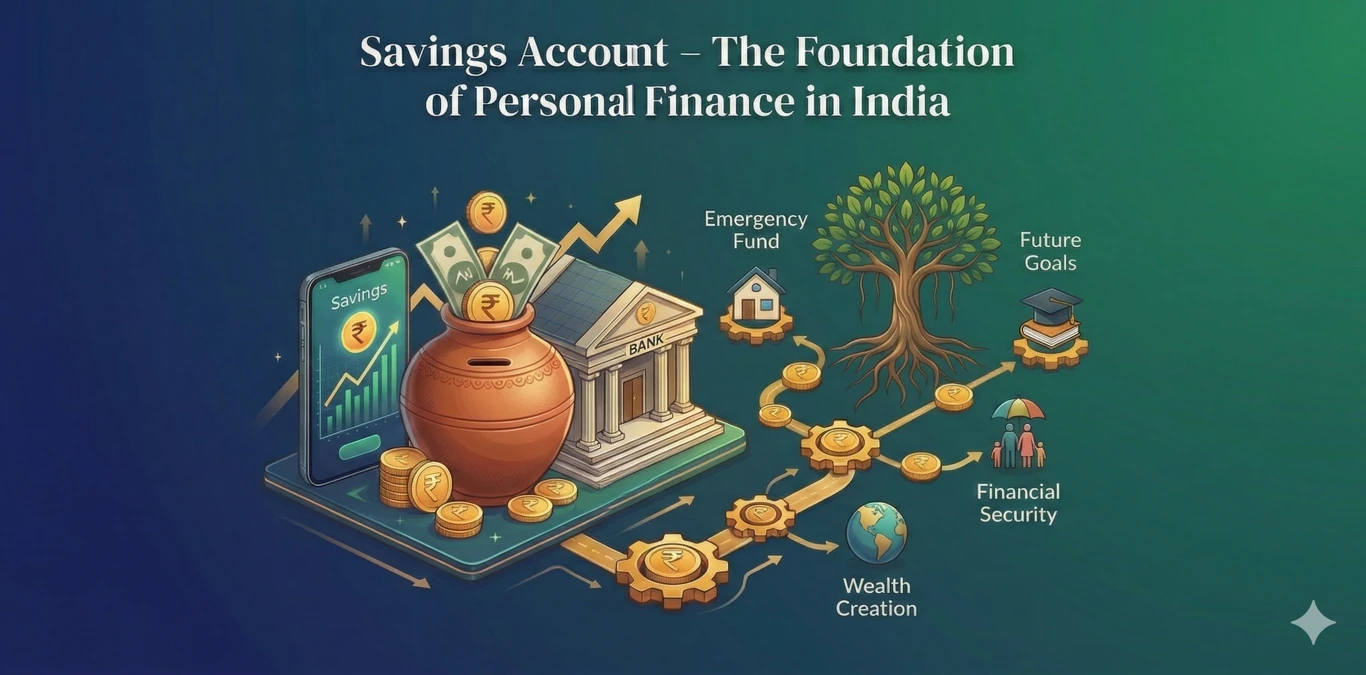
The first time Indians engage with the formal banking system is through a savings account. The savings account is the fundamental component of personal finance in India, whether individuals use it to receive a salary, deposit scholarship funds, save for future goals, or receive government subsidies. Savings accounts have evolved from straightforward passbook-based deposit options to sophisticated financial instruments linked to digital payments, investments, insurance, and government welfare schemes.
Through initiatives such as the Pradhan Mantri Jan Dhan Yojana (PMJDY), Direct Benefit Transfer (DBT), Aadhaar-based authentication, and UPI, India’s drive for financial inclusion has made savings accounts accessible even in remote rural areas. In today’s world, a savings account serves as a gateway to the entire financial ecosystem in addition to being a place where you keep money.
This blog explains the concept of a savings account in depth, its features, benefits, types, interest calculation, eligibility, common mistakes, and its role in building long-term financial discipline in the Indian context.
What is a Savings Account?
Banks design savings accounts primarily for individuals to store money safely while earning interest. It allows account holders to deposit funds, withdraw money when required, and carry out routine financial transactions. Unlike current accounts, which are meant for businesses, savings accounts are intended for personal use and household financial management.
In India, the Reserve Bank of India (RBI) regulates savings accounts. The RBI requires banks to follow specific guidelines related to interest rates, Know Your Customer (KYC) norms, minimum balance requirements, and customer protection. This regulation ensures safety, transparency, and reliability for account holders.
Banks typically provide savings accounts with facilities such as a debit card, ATM access, internet banking, mobile banking, UPI, a chequebook, and SMS alerts, making it an essential financial tool in everyday life.
Evolution of Savings Accounts in India
In the past, physical passbooks and manual bank branch transactions were used to manage savings accounts. Withdrawals and deposits required standing in long queues, and banking hours were limited. Savings accounts have evolved into digital-first products over time due to technological advancements.
The introduction of Core Banking Solutions (CBS) enabled customers to access their accounts from any branch. Subsequently, the introduction of ATMs, online banking, mobile banking apps and UPIs completely changed how people use their savings accounts. Nowadays, a smartphone is used for the majority of transactions, including investments and bill payments, straight from a savings account.
Government-led initiatives such as Jan Dhan accounts have further expanded access by allowing zero-balance accounts for economically weaker sections, ensuring that every citizen has a basic banking facility.
Key Features of a Savings Account
1. Interest Earnings
Savings accounts earn interest on the balance maintained. Interest rates typically range between 2.5% and 5% per annum, depending on the bank. While public sector banks generally offer lower interest rates, some private and small finance banks provide higher rates to attract customers.
Interest is usually calculated on a daily balance basis and credited quarterly or monthly. Though the returns are less, savings accounts offer liquidity and safety, making them suitable for emergency funds.
2. Easy Accessibility
Savings accounts provide easy access to funds through multiple channels such as ATMs, debit cards, UPI, net banking, and mobile banking. This accessibility ensures that money can be withdrawn or transferred anytime, anywhere.
3. Minimum Balance Requirement
Many savings accounts require customers to maintain a minimum balance. This amount varies based on the type of account and location (urban, semi-urban, or rural). However, zero-balance savings accounts are also widely available, especially under government schemes.
4. Digital Integration
Modern savings accounts are fully integrated with digital platforms. Account holders can pay utility bills, recharge mobile phones, invest in mutual funds, buy insurance, and even apply for loans directly from their bank account interface.
5. Eligibility for Government Benefits
Savings accounts are essential for receiving government subsidies, pensions, scholarships, and welfare payments under Direct Benefit Transfer (DBT) schemes. Without a savings account, accessing such benefits becomes difficult.
Types of Savings Accounts in India
Regular Savings Account
This is the most common type of savings account offered by banks. It comes with basic features such as interest earnings, ATM access, and online banking facilities.
Zero-Balance Savings Account
These accounts do not require maintaining a minimum balance. Jan Dhan accounts fall under this category and are aimed at promoting financial inclusion.
Salary Savings Account
Offered to salaried individuals, these accounts often come with zero balance requirements and additional benefits like free debit cards, insurance cover, and preferential loan rates.
Senior Citizen Savings Account
Designed for individuals above a certain age (usually 60 years), these accounts may offer higher interest rates and priority banking services.
Children’s Savings Account
Banks open these accounts in the names of minors, and guardians operate them. They help inculcate saving habits from an early age.
Benefits of a Savings Account
Safety of Money
Banks provide a secure environment for storing money, supported by strong regulatory oversight. In India, the Deposit Insurance and Credit Guarantee Corporation (DICGC), a wholly owned subsidiary of the Reserve Bank of India, insures savings deposits up to ₹5 lakh per depositor per bank. This insurance cover protects depositors in the unlikely event of a bank failure, significantly reducing the risk associated with keeping cash at home. Combined with RBI regulation and banking safeguards, this makes savings accounts one of the safest ways to hold money.
Liquidity for Emergencies
Savings accounts allow quick access to funds during emergencies such as medical expenses or sudden financial needs.
Encourages Financial Discipline
Regular deposits into a savings account encourage disciplined saving habits and better money management.
Gateway to Financial Products
A savings account acts as the entry point to loans, credit cards, fixed deposits, mutual funds, and insurance products.
Financial Inclusion
Savings accounts enable participation in the formal economy and access to government schemes and subsidies.
Role of Savings Account in Personal Financial Planning
A savings account plays an important role in managing short-term financial needs and emergency funds. Financial experts often recommend keeping at least three to six months’ worth of expenses in a savings account for emergencies. While it is not ideal for long-term wealth creation due to lower returns, it provides stability and liquidity.
Savings accounts also help track income and expenses, making budgeting easier. With digital statements and transaction alerts, individuals gain better control over their finances.
Common Mistakes to Avoid
- Keeping excessive idle money instead of investing surplus funds
- Ignoring minimum balance requirements and paying unnecessary penalties
- Not updating KYC details, leading to account restrictions
- Falling for phishing scams due to lack of awareness
Conclusion
A savings account is the backbone of everyday banking and an essential tool for managing personal finances in India. It offers safety, liquidity, and convenience while serving as the foundation for accessing advanced financial products and services. Although a savings account does not generate long-term wealth, a well-managed savings account is indispensable for financial stability, inclusion, and disciplined money management. Every individual, regardless of income level, should understand and effectively use a savings account as the first step toward financial well-being.