In almost every Indian household, money conversations revolve around one common idea i.e. “Save money.” From childhood, we are taught to don’t waste, keep money safely in the bank and think twice before spending. For decades, this habit of saving has protected families from uncertainty. However, in today’s world of rising costs, higher aspirations and longer life expectancy, only saving is often not enough.
At the same time, we see advertisements about mutual funds, stock markets, SIPs and wealth creation. Many young professionals are investing early. Social media is full of discussions about stock market returns and financial freedom. This creates confusion, is saving outdated? Is investing risky?
The truth is simple and powerful, saving and investing serve different purposes and both are equally important. Understanding their differences can completely change how you manage your money.
To understand this clearly, instead of starting with definitions and financial terms, let us first look at a few simple, real-life situations that many of us experience.
Let’s Look at Some Real-Life Examples
Consider a young software engineer earning ₹80,000 per month. If she spends ₹50,000 and invests everything else without building an emergency fund, she may face trouble during unexpected job loss. In this case, saving should come first.
Now consider a 40-year-old government employee who has accumulated ₹20 lakh in FDs but has no exposure to equity. If he plans to retire in 20 years, relying entirely on FDs may not provide adequate growth. In this case, gradual investment in balanced mutual funds can improve long-term outcomes.
Let us look at another example, parents planning for their child’s higher education after 15 years should invest rather than only save. Education costs rise faster than general inflation. Long-term investing helps bridge that gap.
These examples show that the answer is not “saving or investing.” The answer depends on purpose and time.
What is Saving?
Saving means keeping aside money in a safe place for short-term needs, so that it is available when you need it. The main purpose of saving is not to grow money aggressively but to protect it and keep it accessible. When you save, your priority is not to earn high returns. Your priority is protecting the money.
In India, the most common form of saving is a bank savings account. Almost every salaried person has an account in banks. The interest earned is usually modest, often between 2.5% and 4% per year. The money is easily accessible through ATMs, UPI, net banking and debit cards. This accessibility is the biggest strength of saving accounts.
Another popular saving option is the fixed deposit (FD). In an FD, you deposit money for a fixed period and earn a predetermined rate of interest. Many Indian families prefer FDs because they are considered safe and predictable. Recurring deposits (RDs) are another disciplined way to save monthly for a short-term goal.
Then there is the Public Provident Fund (PPF), which is a long-term saving scheme backed by the government. It offers safety and tax benefits but it comes with a long lock-in period. While PPF is often classified as an investment due to its tenure, its structure is conservative and capital-protection oriented, which aligns closely with traditional saving behaviour.
The core idea of saving is stability. If you lose your job, face a medical emergency or need money for a sudden expense, savings protect you. It is ideal that you should have at least six months’ worth of essential expenses kept in savings as an emergency fund. In practical terms, this means calculating your monthly necessary expenses such as rent or EMI, groceries, utilities, school fees, insurance premiums, loan EMIs, basic transport, medical needs, etc. and multiplying that number by six.
Imagine a person earning ₹60,000 per month. If their monthly expenses are ₹40,000 and they lose their job unexpectedly, having six months of expenses saved i.e ₹2,40,000 (40,000 * 6) can prevent financial stress and debt. That peace of mind cannot be measured in percentage returns.
However, saving has a limitation. The returns are usually lower than inflation. If inflation in India averages around 6% and your savings account gives 3%, your purchasing power slowly reduces. Over long periods, money that only sits in savings accounts may not grow meaningfully. That is where investing comes in.
What is Investing?
Investing means putting money into assets with the expectation that it will grow over time. Unlike saving, investing involves risk. The value of your investment can go up or down. However, the goal is long-term growth that beats inflation and builds wealth.
In India, investing has become more accessible in the last decade. Mutual funds have grown rapidly, especially through Systematic Investment Plans (SIPs). Asset management companies manage money from lakhs of investors across the country. With a SIP, even ₹500 or ₹1,000 per month can be invested in diversified portfolios.
The stock market is another important investment avenue for individuals who are willing to take calculated risks in exchange for potentially higher returns. In simple terms, when you invest in the stock market, you buy shares of companies listed on exchanges such as the National Stock Exchange or the Bombay Stock Exchange. By purchasing a share, you become a partial owner of that company. If the company grows and becomes more profitable, the value of your shares can increase and vice-versa. Some companies also distribute a portion of their profits as dividends.
Investing also includes options like equity-linked savings schemes (ELSS), real estate, gold ETFs and even government bonds. All these instruments carry varying levels of risk and return.
The fundamental reason for investing is inflation. In India, the cost of education, healthcare, housing and lifestyle expenses has consistently increased. A college education that costs ₹10 lakh today may cost ₹25–30 lakh in 15 years. If you only save in low-interest instruments, your money may not keep up with rising costs.
Investing allows compounding to work in your favour. Compounding means earning returns not only on your original money but also on the returns generated earlier. Over 15 or 20 years, this can make a dramatic difference.
“Compound interest is the eighth wonder of the world. He who understands it, earns it…he who doesn’t……pays it.”- Albert Einstein.
However, investing requires patience and emotional discipline. Markets fluctuate. There will be periods when your portfolio shows losses. Many first-time investors panic during market corrections and exit at the wrong time. Investing rewards those who stay consistent.
The Difference Between Saving and Investing
The difference between saving and investing is not just about returns; it is about purpose. Here is a simple comparison:
| Factor | Saving | Investing |
| Purpose | Safety and short-term needs | Growth and long-term goals |
| Risk | Very low | Moderate to high |
| Returns | Low and stable | Higher but fluctuating |
| Time Horizon | Short-term | Long-term |
| Liquidity | High | Depends on asset |
| Inflation Protection | Weak | Strong (especially equity) |
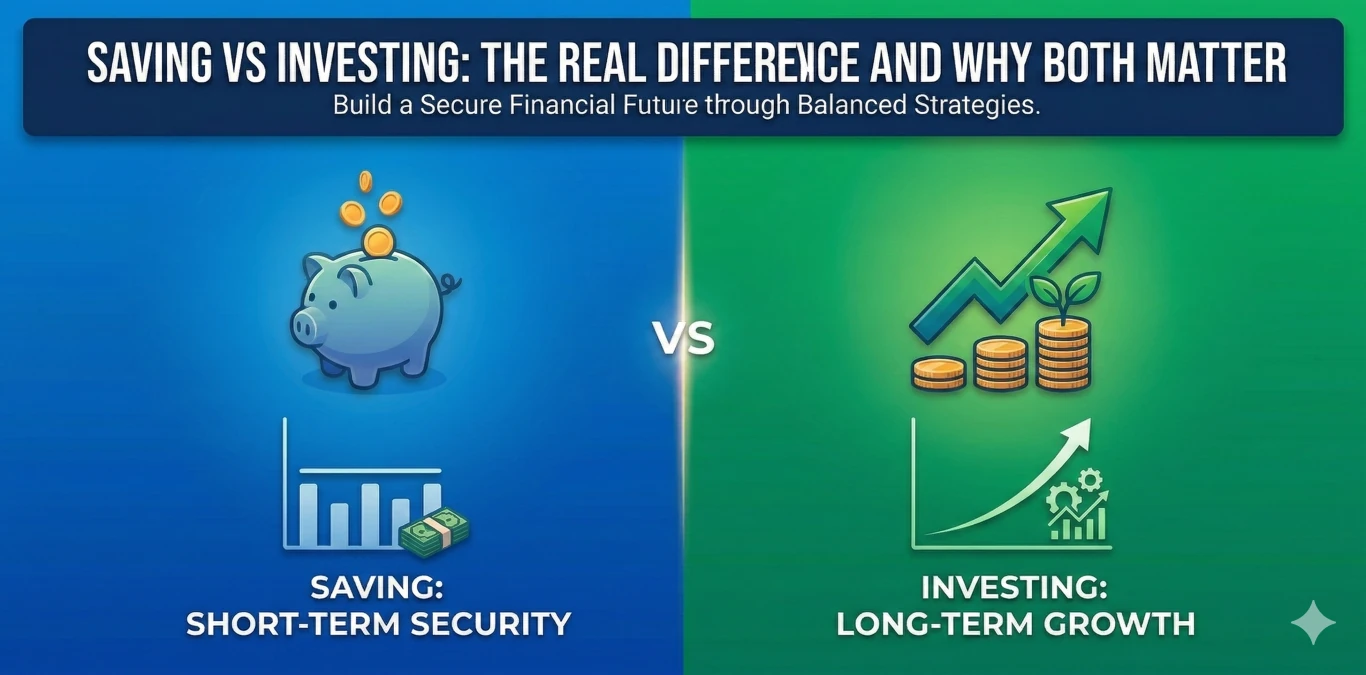
Saving is about protection. Investing is about growth.
Saving is short-term focused. Investing is long-term focused.
Saving offers predictability. Investing offers potential.
Saving minimizes risk. Investing accepts risk in exchange for higher returns.
When you save, you are building a financial cushion. When you invest, you are building wealth.
For example, if you plan to buy a car within one year, putting that money in the stock market is risky. A market downturn could reduce your money just when you need it. In this case, saving through an FD or short-term deposit makes more sense.
But if you are 30 years old and planning for retirement at 60, keeping all your money in FDs may not help you accumulate enough wealth. Over 30 years, inflation will reduce the real value of your money. In such cases, investing in equity mutual funds through SIPs becomes a sensible approach.
Another important difference is emotional impact. Savings give comfort because the balance rarely decreases. Investments can cause anxiety because values fluctuate daily. Understanding this psychological difference is crucial. Many people avoid investing simply because they fear temporary losses.
Advantages and Disadvantages in Practical Terms
Saving offers security and immediate access. It helps you avoid debt during emergencies. It reduces stress. However, it rarely makes you wealthy. If you rely only on savings, your money may grow slowly and long-term goals like retirement or children’s higher education may become challenging.
Investing offers the potential to create significant wealth over time. It can help you achieve financial independence. It can generate returns that beat inflation. However, investing requires discipline, knowledge and patience. Poor decisions, lack of diversification or emotional reactions can lead to losses.
Neither saving nor investing is superior. The superiority depends on the goal and time horizon.
A Balanced Approach
The most sensible financial strategy is a combination of both.
First, build an emergency fund covering at least six months of expenses. Keep it in a savings account or liquid instrument. This is non-negotiable.
Second, secure yourself with health insurance and term life insurance. Protection comes before growth.
Third, start investing for long-term goals through SIPs or diversified instruments regulated by the Securities and Exchange Board of India. Consistency matters more than timing the market.
As income increases, increase investments. Avoid lifestyle inflation where every salary increment leads only to higher spending.
Why Understanding This Difference Is So Important
India is changing rapidly. Life expectancy is increasing. Traditional pension systems are shrinking in the private sector. Healthcare costs are rising. Education expenses are climbing. Depending only on savings, as previous generations did, may not be enough.
At the same time, reckless investing without a safety net can cause stress and financial setbacks.
Financial literacy today means understanding how to use saving and investing strategically. Saving protects you from short-term shocks. Investing prepares you for long-term growth.
If you are young, investing early can give you the power of time and compounding. If you are older, disciplined investing combined with strategic saving can still improve your financial stability.
Conclusion
Saving and investing are not rivals. They are complementary tools in personal finance.
Saving gives you security, liquidity and peace of mind. It protects you during uncertain times. It supports short-term goals and emergencies.
Investing gives you growth, wealth creation and the ability to beat inflation. It supports long-term dreams like retirement, home ownership and children’s education.
If you only save, your money stays safe but may not grow enough. If you only invest without savings, you may face financial stress during emergencies.
The wise approach is balance. Build a strong foundation through saving. Then use investing to create wealth over time. Understand your goals, your time horizon and your risk capacity.
In the end, money management is not about choosing between saving and investing. It is about knowing when to protect your money and when to grow it.
That understanding can transform not just your bank balance, but your entire financial future.