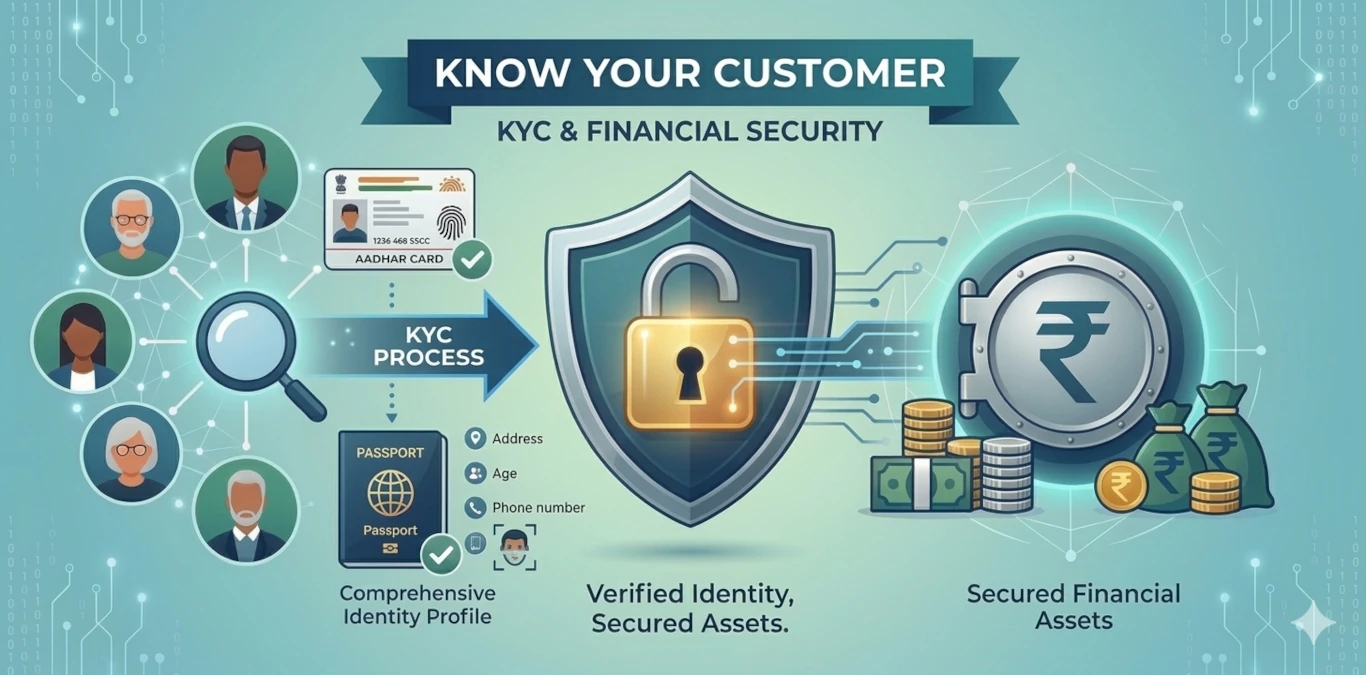
Know Your Customer – KYC and Financial Security
In today’s fast‑growing digital financial system, trust and security are as important as convenience. Every day, millions of banking and investment transactions occur across India. These happen through banks, mutual funds, stock markets, insurance companies, fintech apps, and digital wallets. A strong verification mechanism prevents fraud, money laundering, terrorism financing or identity theft in the vast financial ecosystem. This mechanism is called KYC (Know Your Customer).
KYC norms form the backbone of financial security in India. KYC is mandatory for financial actions. These actions include opening a savings account, investing in mutual funds, applying for a loan, buying insurance, contributing to pension schemes like NPS (National Pension Scheme), trading in the stock market, etc. While many people see KYC as a one‑time paperwork requirement, its importance goes much deeper. KYC protects not only banks and financial institutions but also ensures financial security for customers.
In this article, let’s understand what KYC is and why it is required. We will explore how it works in India and the documents needed. The article also covers the different types of KYC and common issues faced by customers. Finally, we will examine how KYC and financial security are closely linked in strengthening the overall financial system.
What is KYC?
KYC (Know Your Customer) is a mandatory verification process. In this process, banks and financial institutions verify the identity and address of their customers. KYC must be completed before you can access financial services. The purpose of KYC is to ensure that financial services are provided only to genuine individuals and entities. It also aims to prevent misuse for illegal activities.
In simple words, KYC allows a bank or financial institution to verify three key things:
- Who are you?
- Where do you live?
- Are you a legitimate customer?
In India, authorities such as the Reserve Bank of India (RBI), Securities and Exchange Board of India (SEBI), Insurance Regulatory and Development Authority of India (IRDAI) and Pension Fund Regulatory and Development Authority (PFRDA) regulate the KYC norms
Key Regulatory Bodies and KYC Focus Areas:
- Reserve Bank of India (RBI):
Regulates banks, Non-Banking Financial Companies (NBFCs), and payment systems. It mandates strict KYC and anti-money-laundering (AML) policies, including requirements for walk-in customers and high-value transactions. - Securities and Exchange Board of India (SEBI):
Governs KYC for market participants like stockbrokers, investment advisors, and mutual funds. Its rules ensure proper investor identification and help prevent fraud in the securities market. - Insurance Regulatory and Development Authority of India (IRDAI):
Requires insurers to verify the identity of policyholders and beneficiaries. Strong KYC checks help prevent misuse of insurance policies and ensure benefits reach the right person. - Pension Fund Regulatory and Development Authority (PFRDA):
Regulates pension schemes such as the National Pension System (NPS) and Atal Pension Yojana (APY). It requires KYC verification to open and operate pension accounts. This ensures that contributions, withdrawals, and pension benefits are linked to the correct individual. It also keeps the accounts secure.
Without completing KYC, you will face restrictions such as frozen accounts, blocked transactions, inability to invest, or even rejection of loan applications.
Why KYC is Necessary
India’s growing use of digital banking, UPI, and online investments has made financial services faster and easier. However, it has also increased the risk of fraud and illegal activities. KYC helps reduce these risks by ensuring that only genuine individuals can access financial services.
Preventing Fraud
KYC helps prevent fake accounts, identity misuse, and impersonation. By verifying documents like Aadhaar and PAN, financial institutions ensure that the person opening an account is genuine.
Preventing Illegal Activities
Strict KYC rules stop people from using financial services for illegal activities. By tracking transactions and identifying suspicious behaviour, KYC makes it difficult to hide illegally earned money or misuse funds for unlawful purposes.
Protecting You
KYC reduces the chances of unauthorized transactions and misuse of your account. This helps protect you from financial loss and makes the overall banking system safer and more reliable.
Documents Required for KYC
To complete KYC, you need to submit Proof of Identity (POI) and Proof of Address (POA). Common KYC documents include the Aadhaar card, which can serve as both identity and address proof and supports instant e-KYC through OTP or biometric verification.
The PAN card is mandatory for many financial activities. These include opening bank accounts, investing, and filing income tax returns. It helps track financial transactions. Financial institutions also accept documents like a passport and voter ID card as valid identity and address proof.
Depending on the institution and the type of service, you may also be asked to submit additional documents such as a driving licence, utility bills, or bank statements.
CKYC (Central KYC)
The Government of India introduced CKYC (Central Know Your Customer) as a centralized KYC system. It is managed by the Central Registry of Securitisation Asset Reconstruction and Security Interest of India (CERSAI). Under CKYC, you only need to complete KYC once, and your details are stored in a central database.
Once your CKYC is successfully completed, you’ll receive a 14-digit CKYC number. You can share this number with banks, mutual funds, insurance companies, pension providers, and other financial institutions. They can access your KYC details directly from the central registry. This means you don’t have to submit the same documents again.
Keep your CKYC Number safe and share it only with trusted financial institutions. To get your CKYC Number / CKYC Card on your mobile, dial toll free number- 7799022129.
Benefits of CKYC:
- One KYC can be used for all financial products, so you don’t need to submit documents repeatedly
- Your information is shared securely and only with your consent
- Helps you open accounts faster and more easily
- Any update you make is reflected across all linked financial services
- Accepted and recognized by all financial institutions
CKYC is useful for everyone who use multiple financial products like bank accounts, mutual funds, insurance policies, availing loans, etc.
Types of KYC in India
Physical KYC
In physical KYC, you submit photocopies of your documents and complete in-person verification at a bank branch or authorized center. This method can take more time, but it’s still used in certain situations.
e‑KYC
e‑KYC is a paperless process that uses Aadhaar authentication. It allows instant verification, and banks, mutual funds, and fintech platforms widely use it.
Video KYC (V-CIP)
Video KYC is a recent innovation where you complete your KYC through a live video interaction. It’s convenient, secure, and increasingly popular for opening accounts online.
Importance of KYC
KYC plays an important role in ensuring your banking services continue without interruption. When you keep your KYC updated, banks allow you to use your accounts without restrictions. If your KYC is incomplete or outdated, banks may limit transactions. They might even freeze your account. This can disrupt your everyday banking transactions.
KYC also allows you to access a wide range of financial products. Once your KYC is complete, you can invest in mutual funds, apply for loans, use credit cards, and access advanced banking services. Without completing KYC, banks and financial institutions will not allow you to use these services.
Keeping your KYC updated also helps you complete transactions faster. When your records are in order, banks and financial institutions can process transactions, approvals, and redemptions without delays. This saves time and makes financial services more convenient.
KYC also protects you and the financial system. By verifying your identity and keeping records updated, KYC reduces the risk of fraud, misuse of accounts, and unauthorized transactions. This makes financial services safer and more reliable for everyone.
Common KYC Issues Faced by Customers
- Mismatch in name or address across documents
- Outdated address details
- Inactive PAN or Aadhaar linking issues
- Failure to update KYC periodically
Resolving these issues early helps avoid service disruptions.
Myths About KYC
Myth 1: KYC is required only once
Fact: KYC may need periodic updates, especially when there is a change in address, contact details, or as required by regulations.
Myth 2: KYC is only for banks
Fact: KYC applies to all financial services, including mutual funds, insurance, stock markets, loans, and digital payment platforms.
Myth 3: KYC invades privacy
Fact: KYC is regulated by law. The financial institutions must protect customer data and use it only for lawful purposes. KYC plays an important role in financial security while respecting customer privacy.
Conclusion
KYC is not just a regulatory formality—it is a critical pillar of financial security and transparency. By verifying customer identity and address, KYC protects individuals, financial institutions, and the economy from fraud and misuse. For you, completing and updating KYC ensures uninterrupted access to banking, investments, loans, and insurance services. As India advances in its journey, the nation moves toward a fully digital and inclusive financial system. KYC will continue to be a cornerstone of trust and safety for all stakeholders.