Imagine investing your entire savings into a single company because everyone around you says it’s the next big thing. For a while, the price climbs, and everything looks perfect. Then suddenly, the market shifts, the company struggles, and your entire investment drops dramatically.
This scenario is more common than many investors realize. Markets move unpredictably, industries evolve rapidly, and even the strongest companies can face unexpected challenges. The question, then, is not whether risk exists in investing—it always does—but how we manage it intelligently.
This is where portfolio diversification becomes one of the most powerful principles in investing.
Diversification is often described as the practice of “not putting all your eggs in one basket.” But the concept goes much deeper than this familiar phrase. When applied thoughtfully, diversification can help investors reduce risk, stabilize returns, and build long-term financial resilience.
In this article, we’ll explore the most important and sometimes surprising insights about diversification—what it means, why it matters, and how investors can apply it effectively. Whether you are a beginner building your first portfolio or someone refining a long-term strategy, understanding diversification can dramatically change the way you approach investing.
What Is Portfolio Diversification?
In simple terms, portfolio diversification means spreading your money across different types of investments instead of putting it all in one place.
It is a risk-management strategy where various investments are combined within a single portfolio. When one investment underperforms, another may perform well, helping stabilize the portfolio.
Think of it as your financial safety net.
You can reduce the chances of any setback by allocating your capital across different asset classes, which could damage your entire financial plan.
Management thinker Peter Drucker once said:
“The only thing we know about the future is that it will be different.”
And that perfectly captures why diversification matters. Nobody can predict which asset class will perform well next year or next decade. Hence, the smartest approach is to hold a mix of them.
This isn’t indecision. It’s preparation.
Example of a Non-Diversified Portfolio
An investor who invested all his hard earned money into a single company’s stock. He is exposed to the most significant risk. Let’s say, if that company experiences any trouble, the investor could lose a large portion of their wealth.
Example of a Diversified Portfolio
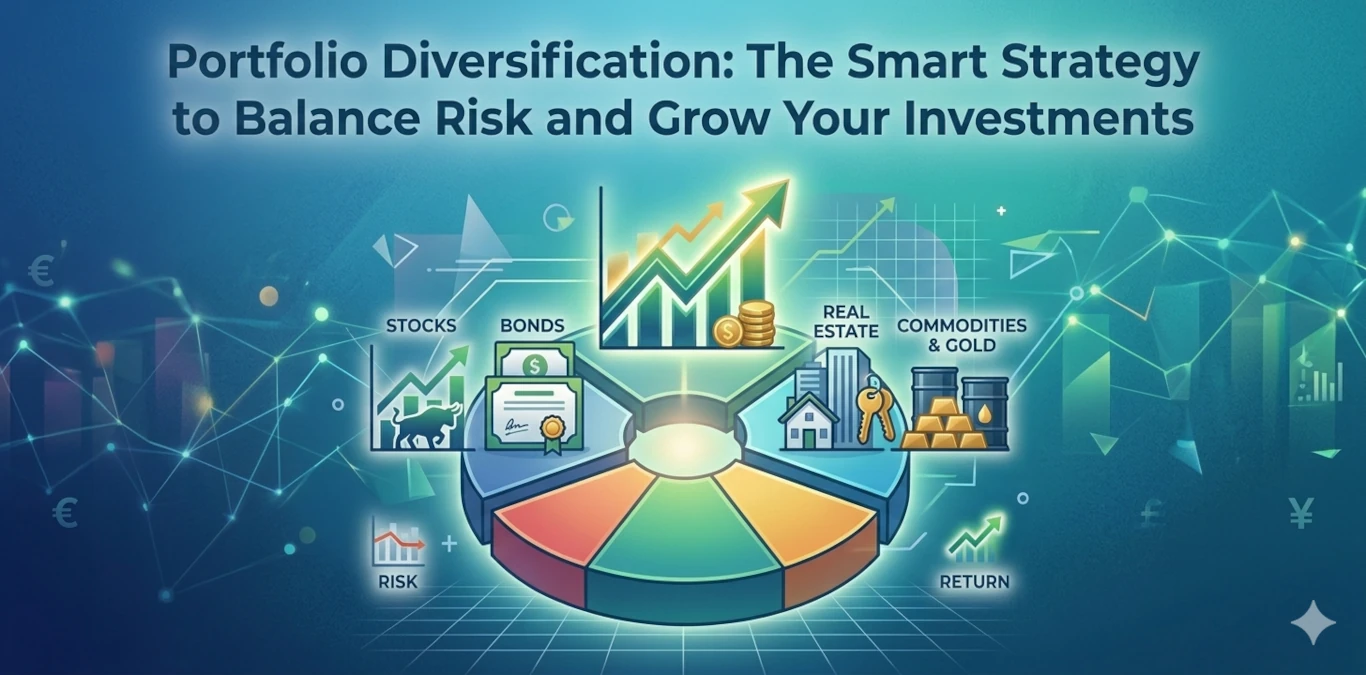
A diversified portfolio might include:
- Stocks from different industries
- Government and corporate bonds
- Real estate investments
- Commodities such as gold
- International assets
If one asset class declines, others may remain stable or increase in value.
The Principle Behind Diversification
The effectiveness of portfolio diversification is based on a key investment concept that is different assets respond differently to economic conditions.
For example:
- Stocks may perform well during economic expansion.
- Bonds may provide stability during market downturns.
- Gold often performs well during periods of uncertainty.
By combining these assets, investors can create a more balanced investment portfolio.
Why Diversification Matters
Diversification is widely considered one of the most important principles in portfolio management because it helps investors manage risk while still participating in potential market growth.
1. Protection Against Market Volatility (Headging)
Markets rarely move smoothly. Diversification is closely linked to the concept of correlation. Correlation measures how investments move relative to each other:
- High correlation: assets move in the same direction.
- Low or negative correlation: some assets rise while others fall.
For example:
- If stock markets are falling sharply
- Bonds or gold may remain stable
- Commodities might even rise
2. It Helps Smooth Returns Over Time
Investment markets move in cycles. Different sectors perform well during different economic phases.
For example:
| Economic Phase | Asset Types That Often Perform Well |
| Economic expansion | Stocks |
| High inflation | Commodities, real estate |
| Economic slowdown | Bonds, defensive stocks |
A diversified portfolio allows investors to participate in multiple cycles, leading to more stable long-term performance.
3. It Protects Against Unpredictable Events
Markets can be disrupted by unexpected events:
- financial crises
- geopolitical tensions
- pandemics
- technological disruption
No one can predict these events consistently. Diversification serves as a defensive mechanism against such uncertainties.
“Diversification is protection against ignorance.”
— Warren Buffett
This quote highlights a key truth: since the future cannot be predicted with certainty, spreading risk is a rational strategy.
4. It Encourages Long-Term Investing Discipline
Diversified investors are less likely to panic during market volatility.
When a portfolio contains multiple asset classes, short-term losses in one area are less alarming, making it easier to stay invested for the long term.
And long-term investing is often where the greatest wealth creation occurs.
5. Emotional Stability for Investors
Investing isn’t just about numbers but it’s also about psychology.
Imagine your entire portfolio falling 40%. Most people would panic. Some would sell everything just to stop the pain.
But a diversified portfolio may decline far less during the same downturn. A 10–15% drop still hurts, but it’s manageable. It becomes easier to stay invested and wait for markets to recover.
That emotional stability also makes the difference between long-term success and costly mistakes.
Which Asset Classes to Consider: Building the Foundation of Diversification
Creating a well-diversified portfolio is a bit like painting. You need different colours, each with its own role. Effective diversification begins with investing across multiple asset classes. Each asset class behaves differently in response to economic conditions.
Below are some of the most common categories investors consider.
1. Stocks (Equities)
Stocks represent ownership in a company. When you invest in equities, you participate in the growth of businesses and the broader economy. Over the long term, stocks have historically provided higher returns than many other asset classes, making them a key component of most investment portfolios.
However, stock prices can fluctuate significantly in the short term due to market sentiment, economic changes, or company performance. To reduce risk, investors often diversify within equities by investing across different industries, company sizes such as large-cap and small-cap firms, and companies in different countries.
Key highlights
- High growth potential
- Higher short-term volatility
- Best suited for long-term wealth creation
2. Bonds (Fixed Income)
Bonds are investments where investors lend money to governments or corporations in exchange for regular interest payments. At the end of the bond’s term, the investor typically receives the original investment amount back. Because of this predictable income stream, bonds are often considered more stable than stocks.
Including bonds in a portfolio can help balance risk, especially during periods when stock markets decline. Investors can diversify within bonds by holding government bonds, corporate bonds, municipal bonds, or inflation-linked bonds, each offering different levels of risk and return.
Key highlights
- Provides steady income
- Lower volatility compared to stocks
- Helps stabilize the portfolio
3. Real Estate
Real estate is a tangible asset that can generate income through rent while also appreciating in value over time. Because property markets do not always move in the same direction as stock markets, real estate can add an additional layer of diversification.
You can gain exposure either by buying property directly or through Real Estate Investment Trusts (REITs), which allow individuals to invest in large property portfolios without owning or managing real estate themselves.
Key highlights
- Potential for rental income
- Long-term appreciation
- Can act as a hedge against inflation
4. Commodities
Commodities include physical resources such as gold, silver, oil, and agricultural products. Their prices are driven mainly by supply and demand factors, which means they often behave differently from stocks and bonds.
Because of this unique behavior, commodities can be useful during periods of inflation or economic uncertainty. Gold, in particular, is often viewed as a safe-haven asset and has historically been used by investors to preserve value during market volatility.
Key highlights
- Often performs well during inflation
- Useful as a hedge against uncertainty
- Adds diversification to a portfolio
5. International Investments
Investing internationally allows investors to participate in economic growth beyond their home country. Since different countries experience economic cycles at different times, global investments can reduce reliance on a single market.
International diversification may include developed market stocks, emerging market equities, or international bond funds. By spreading investments across multiple regions, investors can build a more balanced and resilient portfolio.
Key highlights
- Exposure to global growth opportunities
- Reduces dependence on one economy
- Improves overall portfolio diversification
“While choosing the right asset classes is important, diversification is not just about what you invest in. It also depends on how you structure and manage your portfolio over time.”
How to Diversify Your Portfolio Effectively
Diversification doesn’t mean randomly buying different investments. A structured approach works far better.
1. Asset Allocation
The first step is spreading investments across different asset categories such as:
- equities
- bonds
- real estate
- commodities
This type of diversification is known as asset allocation.
For example:
- 60% stocks
- 30% bonds
- 10% alternative assets
This ratio isn’t fixed for everyone. The ideal balance depends on factors such as your risk tolerance, your age and your financial goals.
- If you are young, you might prefer 70% stocks, 10% bonds, 10% in any other assets
- If you are nearing retirement you might shift to 30% stocks and 70% bonds
2. Diversify Within Each Asset Class
Investing in one stock from each sector is not enough. Within equities, investors should consider diversification across industries, company sizes, geographic regions, etc.
This prevents excessive reliance on a single market segment.
3. Geographic Diversification
Many investors unknowingly suffer from home bias. They invest almost entirely in companies from their own country simply because those brands feel familiar.
But if the local economy slows down, their entire portfolio suffers.
4. Rebalancing: The Annual Portfolio Check
Over time, some investments grow faster than others.
Imagine your stocks performing exceptionally well for several years. What began as 60% of your portfolio might gradually grow to 80% or even 90%. While that sounds great, it quietly increases your risk.
Rebalancing means periodically adjusting your portfolio back to its original proportions. This usually involves:
- Selling a portion of the assets that have grown significantly
- Buying more of the assets that have lagged
This maintains the intended risk level.
5. Invest Regularly
Regular investing is often referred as systematic investing. It can help reduce the impact of market timing.
By investing periodically sometimes you buy more units when prices are low and sometimes fewer units when prices are high.
This approach can smooth the average cost of investments over time.
6. Consider Long-Term Investment Horizons
Diversification works best when you maintain a long-term perspective.
Short-term market movements are unpredictable, but diversified portfolios tend to perform more consistently in longer run.
Common Diversification Mistakes
Even investors who try to diversify sometimes fall into subtle traps.
Over-Diversification
Owning too many similar investments doesn’t improve diversification.
For example, holding ten different large-cap mutual funds may sound diversified—but if they all invest in the same top companies, you’re essentially holding the same portfolio multiple times.
The Correlation Trap
Buying several companies from the same sector can create hidden concentration.
Five technology stocks might look like diversification, but they are all tied to the same industry cycle. If tech struggles, they are likely to fall together.
Failing to Rebalance
Without rebalancing, a portfolio may gradually become riskier.
For example, strong stock performance can lead to excessive exposure to equities.
Periodic rebalancing helps maintain the intended risk profile.
Ignoring Inflation
Keeping most of your savings in cash may feel safe, but inflation quietly erodes purchasing power over time.
Without some growth-oriented assets like equities, your money may lose real value year after year.
Case Study: The Power of a Diversified Portfolio
To understand the real impact of diversification, consider two hypothetical investors.
Investor A: Concentrated Portfolio (Non-Diversified)
Investor A puts all savings into technology stocks.
During a technology boom, the portfolio performs exceptionally well.
However, when the sector experiences a downturn, the portfolio drops dramatically.
Investor B: Diversified Portfolio
Investor B invests across stocks, bonds, real estate, international equities, gold.
During a technology downturn technology stocks decline, bonds remain stable, gold rises due to uncertainty, real estate continues generating income.
While the portfolio may still decline slightly, the losses are significantly smaller.
Historical Evidence
Historical market data repeatedly demonstrates diversification benefits.
For instance:
- during the 2008 global financial crisis, stock markets declined sharply
- however, government bonds and gold performed comparatively better
Diversified investors were therefore able to reduce overall losses.
Similarly, during inflationary periods, commodities and real estate often provide resilience when stocks struggle.
The Long-Term Benefits of Diversification
Diversification does not guarantee profits or eliminate losses entirely. However, its long-term advantages are significant.
Key Benefits Include:
- Reduced exposure to individual investment risk
- More stable portfolio performance
- Improved risk-adjusted returns
- Greater resilience during market downturns
Perhaps most importantly, diversification supports consistent long-term investing behavior, which is essential for wealth building.
Many investors fail not because of poor investment choices, but because they react emotionally during market volatility.
Diversified portfolios can help reduce these emotional reactions by smoothing the investment experience.
Conclusion: The Real Power of Balance in Investing
The idea of portfolio diversification appears to be simple at first glance, yet it remains one of the most important principles in investing.
Rather than trying to predict the next winning investment, diversification acknowledges a fundamental truth: the future is uncertain.
By spreading investments across asset classes, industries, and geographic regions, investors create a portfolio that is more resilient, adaptable, and capable of navigating changing economic environments.
Over time, this balanced approach can help investors:
- manage risk more effectively
- maintain stability during market turbulence
- pursue long-term financial growth with greater confidence
Ultimately, diversification is not about eliminating risk—it is about managing it intelligently.
And perhaps the most important question every investor should consider is this:
Are your investments concentrated on a single opportunity, or are they positioned to benefit from the many opportunities the global economy has to offer?
The answer to that question may determine the strength and sustainability of your financial future.