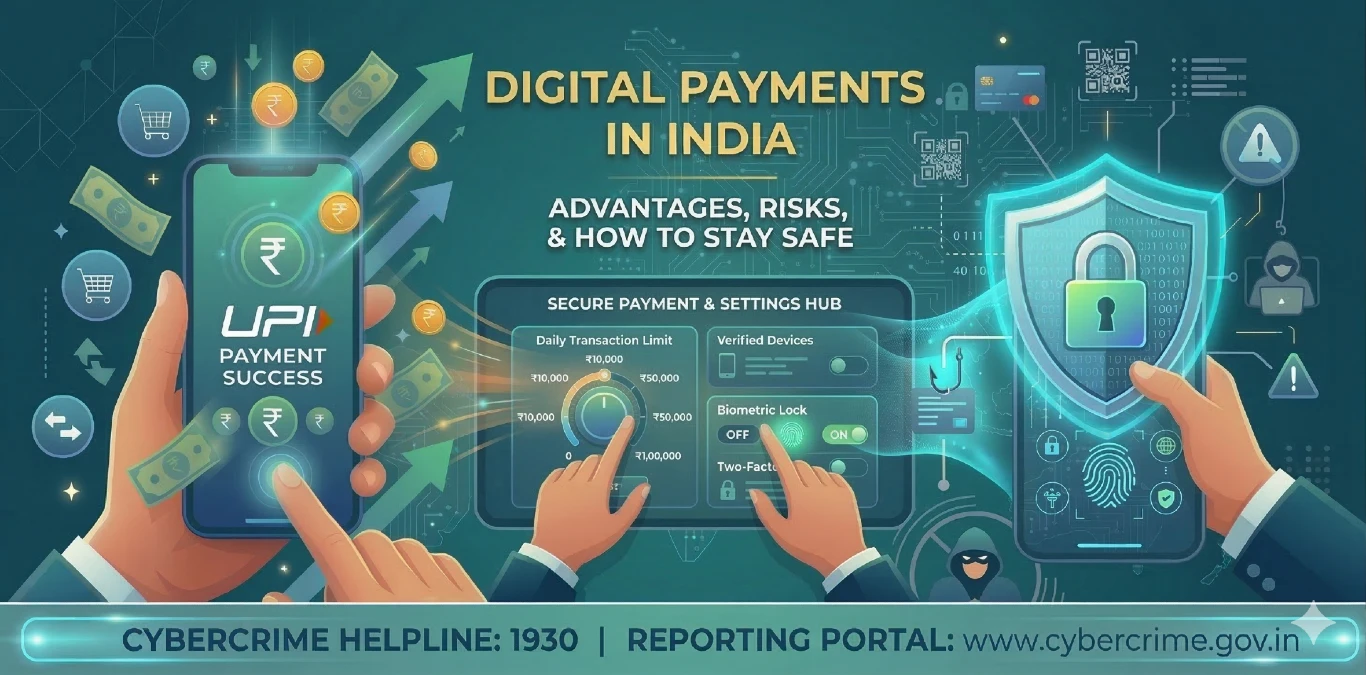
Digital Payments in India: Advantages, Risks, and How to Stay Safe
Ten years ago, stepping out of the house without a thick wallet of cash felt like a massive risk. Buying fresh vegetables, paying a rickshaw driver, or splitting a restaurant bill meant a frantic search for exact change. Today, a quick scan of a QR code does the job in seconds. Think about the last time you paid for something. Maybe you scanned a QR code at a tea stall, paid your electricity bill online or sent money to a friend using your phone.
India has seen an incredible shift from cash to digital transactions. Thanks to innovations like Unified Payments Interface, you can now transfer money instantly with just a smartphone. Payment apps such as BHIM-UPI, Google Pay, PhonePe, and Paytm have made sending and receiving money easier than ever before. This transformation accelerated after the 2016 Indian Demonetization, which pushed millions of people to explore digital payment options.
India has undeniably become the undisputed global king of digital payments. According to data recognized by the International Monetary Fund (IMF), India’s Unified Payments Interface (UPI) processes nearly 49% of the world’s real-time digital transactions.[1] In the 2024–25 financial year alone, India clocked a staggering 186 billion UPI transactions, moving a massive ₹261 lakh crore across the economy.[2]
But as we increasingly trade our physical leather wallets for digital ones, a critical question emerges: Are we truly safe? While digital payments bring convenience and speed, they also come with risks such as fraud, scams, and data privacy concerns. The key is not to avoid digital payments but to understand how they work and how you can use them safely.
Let’s explore both the advantages and risks so you can make smarter and safer financial decisions.
The Transformative Advantages of Digital Payments
Digital payments have changed how we handle money in everyday life. Whether you’re paying bills, shopping online or sending money to family, digital payments offer several benefits.
Convenience in Everyday Transactions
The days of waiting in long bank queues to clear a cheque or transfer funds are long gone. You don’t even need to remember bank account numbers. Systems like UPI, IMPS (Immediate Payment Service) and mobile wallets operate 24/7, 365 days a year. Instead of carrying cash or searching for an ATM, you can simply open a payment app and complete a transaction within seconds.
Whether you are paying for a cup of midnight chai at a local stall or transferring rent to your landlord on a Sunday morning, the money moves instantly.
Instant Transactions Anytime
Another major advantage is speed. Traditional bank transfers could take hours or even days, especially across different banks. But digital payments happen almost instantly. If you need to send emergency money to someone, apps like BHIM-UPI, PhonePe or Google Pay allow you to transfer funds within seconds, even at midnight or on holidays.
Furthermore, innovations like FASTag have completely revolutionized highway travel, using RFID technology to deduct toll payments directly from linked accounts, saving millions of hours and countless liters of fuel across the country.
This real-time capability has made financial transactions much more efficient.
Driving Financial Inclusion
Further, Government initiatives such as Pradhan Mantri Jan Dhan Yojana enabled millions of Indians to open bank accounts. Once people have bank accounts, digital payment platforms make it easier for them to actually use those accounts.
For example, if you live in a rural area, you can now receive government benefits, subsidies, or wages directly into your bank account and access them through digital platforms.
Transparency and Economic Formalization
Cash is anonymous and hard to track, making it the preferred medium for the shadow economy. Digital payments leave a clear, immutable electronic trail. For the everyday consumer, this means an automatic, built-in expense tracker right on their smartphone. For the broader economy, it means improved tax compliance, reduced corruption, and a massive boost to the formal economy.
The Dark Side: Risks of Digital Payments
For all its brilliance, India’s fast-moving digital payment ecosystem comes with a silent footnote: the faster we move our money, the faster criminals try to steal it. As adoption has grown, so has the sophistication of cyber fraud. Fraudsters specifically target these vulnerable demographics such as the senior-citizens, first-time smartphone users and rural citizens, etc. exploiting their lack of digital literacy.
The Explosion of Fraud and Scams
The statistics are sobering. The data reveals a dramatic escalation in cyber-financial crimes in India over the last five years, characterized by a massive surge in both the volume of complaints and the total wealth stolen.
Between 2021 and 2025, the number of financial fraud complaints registered on the National Cyber Crime Reporting Portal (NCRP) skyrocketed from 2.62 lakh to over 24 lakh, representing a nearly ten-fold increase in reported incidents.
The financial impact followed an even more aggressive trajectory. While losses were relatively contained at ₹551 crore in 2021, they exploded by 2024, reaching a peak of ₹22,848 crore. This suggests that cybercriminals shifted their focus toward high-value targets and more sophisticated scams, such as “digital arrests” and “investment frauds”.[3]
Fraudsters are no longer just relying on simple OTP theft. They often try to trick you into revealing sensitive financial information.
Some common scams include:
Phishing Messages
You may receive emails or messages that appear to come from your bank or payment app. These messages often contain links that lead to fake websites designed to steal your login credentials.
Fake Customer Care Calls
Sometimes scammers pretend to be bank officials or technical support agents. They may ask for your OTP or request you to install a remote access app.
If you share these details, they can access your bank account.
QR Code Scams
Many people mistakenly believe scanning a QR code will help them receive money. In reality, scanning a QR code usually means you are making a payment.
Social Engineering Attacks
Sometimes fraudsters don’t rely on technology; they rely on human psychology.
A major modern threat is the “Digital Arrest” scam. In these highly manipulative social engineering attacks, fraudsters impersonate law enforcement (like the CBI or local police) via Skype or WhatsApp. They falsely accuse the victim of money laundering or drug trafficking, intimidate them into isolation, and coerce them into transferring their life savings to “clear their name.”
Fraudsters use this misunderstanding to trick people into transferring money.
Data Privacy Concerns
Every time you use an app, you are generating data. Your purchasing habits, location, and financial capacity are all being recorded. Even though regulated platforms follow strict privacy rules, the large amount of data they store makes their servers attractive targets for hackers.
Fake Apps and Malware
Another common risk comes from fake mobile applications. Cybercriminals sometimes create apps that look identical to legitimate payment apps. Once installed, these apps can steal your banking information.
Many consumers unknowingly grant sketchy third-party apps full access to their SMS inbox (to auto-read OTPs), inadvertently handing over the keys to their bank accounts. Downloading apps only from trusted sources can help you avoid this problem.
Technical Glitches and Infrastructure Blind Spots
Even the best technology fails. We have all experienced the heart-dropping moment when a transaction fails, the money is debited from our account, but the merchant hasn’t received it. While these funds are almost always automatically refunded within a few days, the temporary loss of liquidity can be highly stressful. Additionally, network dead zones in rural areas can suddenly render a digital wallet useless, proving that cash still holds value as a backup.
How You Can Stay Safe While Using Digital Payments
The goal is not to abandon digital payments out of fear, but to use them with confidence and awareness. By following a few non-negotiable best practices, you can easily outsmart cybercriminals.
The Golden Rule: You Only Enter a PIN to SEND Money
This is the most important rule of digital finance. Scammers frequently list fake customer care numbers online or reach out as “buyers” on second-hand marketplaces. They will send you a “payment request” link and tell you to enter your UPI PIN to receive the money.
Fact: You never, ever need to enter a UPI PIN, password or OTP to receive funds into your account. If an app asks for your PIN, money is leaving from your bank account.
Pause, Verify and Defeat “Urgency”
Cybercriminals rely heavily on panic. Whether it’s a message saying your electricity will be cut off in two hours, a text claiming your bank account is frozen or a terrifying “Digital Arrest” video call. Scammers want you to act before you think.
Always pause take a deep breath. Disconnect the call. Independently verify the claim by contacting your bank, the utility company or local authorities through their official, verified channels.
Always Verify Before Sending Money
Before you transfer money, take a moment to verify the recipient’s details. A small typing error in a mobile number or UPI ID could send your money to the wrong person.
Download Apps Only from Trusted Sources
Always download payment apps from official stores like the Google Play Store or Apple App Store. Avoid installing apps from unknown links or websites.
Use Additional Security Features
Most payment apps provide extra security options such as App locks, Fingerprint authentication, Face recognition.
Enabling these features adds another layer of protection.
Monitor Your Transactions Regularly
Check your bank statements and transaction history frequently. If you notice a suspicious transaction, report it immediately to your bank or payment service provider.
You should report financial fraud through the cybercrime helpline 1930 or the portal managed by the Indian Cyber Crime Coordination Centre.
How and Where to Report Digital Fraud: Tools and Resources
If the worst happens and you suspect you’ve been targeted by a scammer, or if a transaction simply goes wrong, panic is your worst enemy. Speed and knowing exactly which tool to use are your best assets. India has developed a multi-layered reporting infrastructure to handle everything from spam calls to outright financial theft.
The 1930 Helpline and NCRP: For Financial Loss
If money has already left your account fraudulently, this is your immediate first stop. Speed is your greatest weapon in the world of digital finance. The Government of India established the National Cyber Crime Reporting Portal (NCRP) and its dedicated toll-free helpline, 1930.
How it works: This system integrates law enforcement agencies, banks, and financial intermediaries in real-time. When you call 1930 immediately after a fraud (known as the “Golden Hour”), the system attempts to track the money trail and freeze the scammer’s destination accounts before they can withdraw the cash.
How to use it: You can call 1930 or log onto cybercrime.gov.in. Keep your 12-digit UTR (Unique Transaction Reference) number, bank account details and screenshots of the fraudulent transaction handy.
As of December 31, 2025, this rapid response infrastructure has successfully saved an astonishing ₹8,189 crore across more than 23.61 lakh complaints. This recovery rate proves that dialing 1930 or visiting cybercrime.gov.in within the crucial “Golden Hour” is highly effective.[4]
The Chakshu Portal (Sanchar Saathi): For Preventing Fraud
What if you get a highly suspicious WhatsApp message offering a fake “work from home” job, but you don’t lose any money? You shouldn’t just ignore it.
How it works: Launched by the Department of Telecommunications (DoT), Chakshu is designed for proactive, citizen-led reporting of suspected fraud communications.
How to use it: Visit sancharsaathi.gov.in, go to the Chakshu section, and upload screenshots of the suspicious call, SMS, or WhatsApp message.
Why it matters: By reporting these attempts, you help the DoT block those numbers, disconnect their telecom resources, and prevent the scammers from successfully targeting someone else.
The RBI Ombudsman (CMS): For Bank Unresponsiveness
If you report a fraudulent transaction or a severe technical glitch to your bank and they fail to reply within 30 days, or if you are unsatisfied with their resolution, you have backup.
How it works: The Reserve Bank of India runs the Complaint Management System (CMS). It is a single-window portal to file complaints against any RBI-regulated entity.
How to use it: Log onto cms.rbi.org.in to file a complaint free of charge. The RBI Ombudsman acts as an impartial mediator to resolve the dispute, often forcing banks to reverse unfair charges.
In-App UPI Dispute Mechanisms: For Everyday Glitches
Not every missing rupee is a crime. Often, server timeouts cause a payment to fail on the merchant’s end while the money is debited from your account.
How it works: The National Payments Corporation of India (NPCI) mandates that all UPI apps have an in-app dispute resolution system.
How to use it: Navigate to your transaction history within your UPI app, select the failed transaction, and tap “Raise Dispute.” Most of these technical drop-offs are automatically reconciled and refunded to your account within 3 to 5 business days.
Conclusion
The digital payment revolution in India is a masterclass in technological scale and public adoption. From bustling metropolitan malls to remote village tea stalls, the ecosystem has made commerce faster, safer, and more inclusive than ever before in human history.
However, Cybercriminals are constantly evolving, relying on our fear, greed and lack of awareness to bypass highly secure banking infrastructures.
By treating your digital credentials with the same caution as your physical wallet, educating the vulnerable people in your life and remembering the golden rule “never enter a PIN to receive money”, you can fully enjoy the incredible benefits of India’s digital economy without falling prey to its risks.
Stay vigilant, stay informed and pay safe!
[1] Source: UPI Recognized as World’s Largest Real-Time Payment System by IMF; Accounts for 49% of Global Transactions : PIB
[2] Source: Product Statistics – UPI : NPCI
[3] Source: https://www.pib.gov.in/PressReleasePage.aspx?PRID=2226441®=3&lang=2
[4] Source: https://www.pib.gov.in/PressReleasePage.aspx?PRID=2226441®=3&lang=2
Frequently Asked Questions (FAQs) About Digital Payments in India


