
Inflation is one of the most important forces shaping our financial life, even if you don’t notice it immediately. It quietly determines how far your money goes. Whether you are a young professional in Bengaluru, a parent in Delhi, or a retiree in Kochi, inflation affects your daily expenses and long-term plans.
You probably notice inflation when onion prices rise or petrol becomes expensive. But inflation is not just about temporary price increases. It reflects a deeper change in the value of our hard-earned money. Over time, it decides how much your salary can buy, how fast your savings grow, and whether your investments keep up with rising costs.
Inflation affects almost every part of our lives. It influences grocery bills, education costs, healthcare expenses, and housing. Moderate inflation is normal in a growing economy like India’s. However, high or unpredictable inflation can make budgeting and financial planning difficult.
In this article, we will understand Inflation and Its Impact on Personal Finance, and what practical steps we can take to protect and grow our money. Once you understand how it works, you can make smarter financial decisions and protect your money from losing value.
What is Inflation?
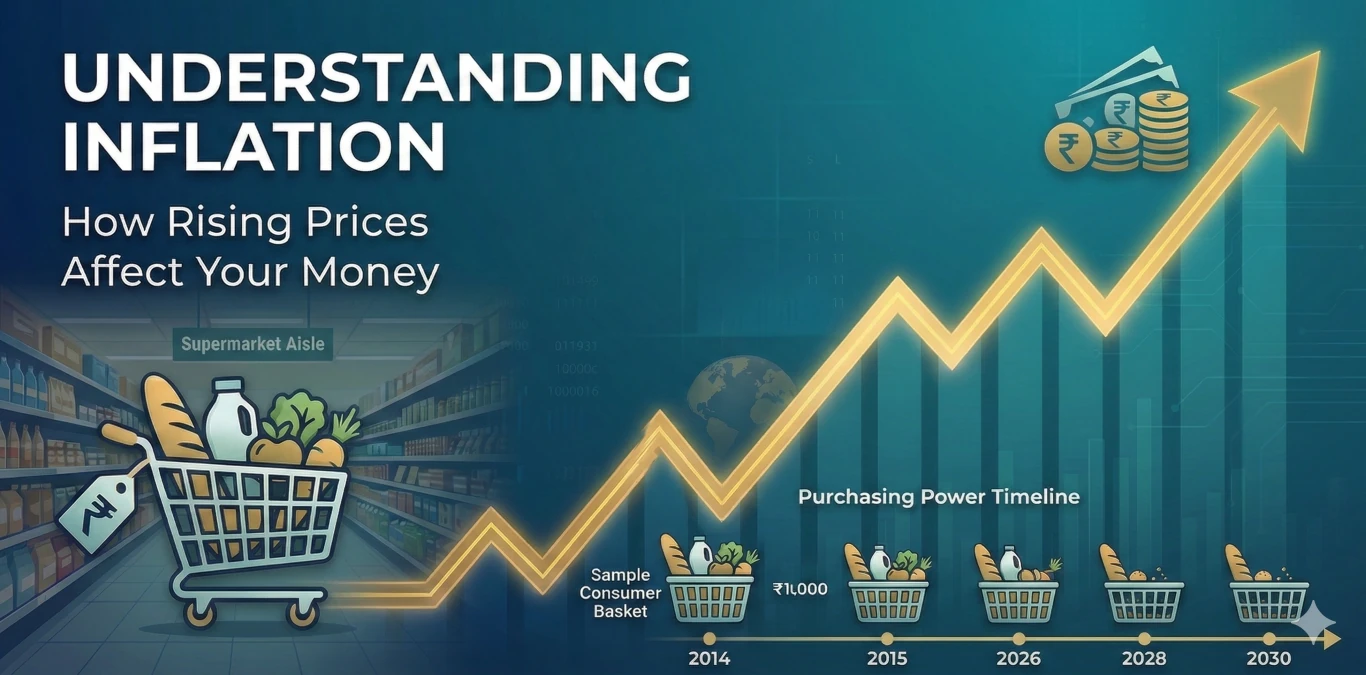
In simple term, Inflation is the rate at which the overall prices of goods and services rise over time. When inflation increases, each rupee you have buys fewer goods and services. It means your purchasing power falls.
If you have ₹100 today and inflation is 5%, that same ₹100 will still be ₹100 next year, but it will buy fewer groceries, less fuel, and maybe one less movie ticket. You haven’t lost money physically, but its value has quietly declined.
Instead of looking at just one product, inflation measures price changes across the economy. Economists track inflation using indices such as the Consumer Price Index (CPI) and the Wholesale Price Index (WPI). These indices measure how the cost of a basket of goods and services changes over time.
Consumer Price Index (CPI):
The Consumer Price Index measures the change in prices of goods and services that you buy for daily living. These include items such as food, fuel, housing, transport, healthcare, and education. CPI reflects the inflation you actually experience in everyday life.
In India, CPI is the main indicator used by the Reserve Bank of India (RBI) to decide interest rates. This is because it directly affects consumers’ purchasing power. It also helps control inflation.
Wholesale Price Index (WPI):
The Wholesale Price Index measures price changes at the wholesale or producer level. It tracks the prices of raw materials, fuel, and manufactured goods before they reach consumers. WPI helps economists understand cost pressures in the production process.
Although WPI does not directly measure retail prices, rising wholesale costs can eventually lead to higher prices for consumers.
Why Inflation Occurs?
Inflation does not arise from a single reason. Instead, it is the result of multiple interacting factors in an economy. These may include increased consumer spending, rising production costs, supply disruptions, changes in money supply, or shifts in expectations about future prices. In growing economies, moderate inflation often accompanies rising incomes and demand.
In India, the Reserve Bank of India (RBI) works to keep inflation low and stable. It aims to ensure that prices do not rise too quickly or fall sharply. The RBI manages inflation by adjusting interest rates. It uses various monetary policy tools to influence borrowing. This impacts spending and overall demand in the economy. Its broader aim is to maintain price stability while also supporting sustainable economic growth.
A moderate level of inflation is generally considered normal in a growing economy. This is because rising incomes and expanding demand can put upward pressure on prices. However, very high inflation can weaken purchasing power, reduce the value of savings, and create uncertainty for households and businesses. On the other hand, extremely low inflation or falling prices can discourage spending and investment, which can slow economic activity. By managing inflation carefully, the RBI seeks to maintain balance and stability in the economy.
Types of Inflation
All inflation is not the same. Economists generally categorize inflation based on its underlying causes. To beat inflation, you first need to understand what causes it.
1. Demand-Pull Inflation
When the total demand for goods and services exceeds the economy’s ability to produce them, it’s called Demand-pull Inflation. When consumers, businesses, and governments all increase spending at the same time, producers may struggle to keep up with the demands. As a result, prices are pushed upward.
This type of inflation is often associated with periods of strong economic growth. Rising incomes, easy access to credit, and optimistic consumer confidence can all fuel demand-pull inflation. For example: if many people suddenly want to buy houses but there are not enough homes available, property prices may rise sharply.
Demand-pull inflation is sometimes summarized as “too much money chasing too few goods.” While it can signal a healthy economy, if left unchecked it may lead to overheating and instability.
2. Cost-Push Inflation
Cost-push inflation arises when the costs of production increase, prompting businesses to raise prices to maintain profitability. Common drivers include higher wages, increased raw material costs, higher energy prices, or supply chain disruptions.
For instance, if fuel prices rise significantly, transportation costs increase. This affects not only petrol or diesel prices but also the cost of moving goods from factories to markets. Eventually, consumers pay more for everyday products.
Unlike demand-pull inflation, cost-push inflation can occur even when demand is weak. This makes it particularly challenging for policymakers, as raising interest rates to curb inflation may further slow economic growth.
3. Built-In Inflation (Wage-Price Spiral)
Built-in inflation, often linked to expectations, occurs when workers and businesses anticipate future price increases and act accordingly. Employees demand higher wages to keep up with the cost of living, and businesses raise prices to cover higher wage bills. This creates a self-reinforcing cycle known as the wage-price spiral.
Expectations play a crucial role here. If people believe inflation will remain high, they adjust their behavior in ways that can actually sustain inflation. Managing expectations is therefore a key task for central banks.
4. Other Common Classifications
Also, inflation is sometimes described using broader terms:
- Creeping or Moderate Inflation: A slow and steady rise in prices, generally considered manageable.
- Galloping Inflation: Rapid inflation that can disrupt economic stability.
- Hyperinflation: Extremely high and often uncontrollable inflation, usually associated with severe economic crises.
While hyperinflation is rare, even moderate inflation can significantly impact long-term financial outcomes if ignored.
Impact of Inflation on Personal Finanace
Inflation does not affect everyone in the same way. While it simply refers to a general rise in prices, its effects are felt differently by consumers, savers, borrowers, and businesses. Over time, inflation reshapes how money is spent, saved, borrowed, and invested across the economy. Understanding these effects helps you make better financial decisions and plan for the future.
1. Consumers: Reduced Purchasing Power
When prices of everyday goods and services rise, your money buys fewer items than before. If your income does not increase at the same pace, you may struggle to maintain your usual lifestyle. You may need to cut back on non-essential spending such as dining out, travel, or entertainment. At the same time, you may have to focus more on essential expenses like food, housing, fuel, and healthcare. Over time, inflation can change your lifestyle and spending habits.
2. Savers: Erosion of Real Value
Inflation can quietly reduce the real value of savings. Money kept in cash or low-interest accounts may lose value if inflation is higher than the interest earned. This means that the same amount of savings will be able to buy fewer goods and services in the future. This is why you need to consider investment options that have the potential to grow faster than inflation. This will help preserve and increase the real value of their money over time.
3. Borrowers: Real Cost of Loan
Moderate inflation can sometimes benefit borrowers. If your income rises with inflation, you may repay loans with money that has lower purchasing power. However, if interest rates rise sharply, borrowing can become more expensive.
4. Businesses: Mixed Impact
For businesses, inflation can have both positive and negative effects. On one hand, companies may be able to charge higher prices for their products and services, which can increase revenues. On the other hand, the cost of running a business may also rise. Expenses such as raw materials, transportation, wages, and energy often increase during inflationary periods. If costs rise faster than selling prices, their profit margins may shrink. Inflation can also create uncertainty, making it harder for businesses to plan investments, set prices, and manage long-term contracts.
Effects on Savings and Investments
This is where the rubber meets the road. Inflation is the natural enemy of the “lazy” saver and the biggest enemy of idle money. This is where inflation matters most for your personal finances.
The “Real” Rate of Return
To know whether your money is actually growing, you must use this simple formula:
Real Return = Nominal Interest Rate – Inflation Rate
If your Savings Account gives you 3% interest but inflation is 4%, you are effectively losing 1% of your wealth every year.
Traditional Savings (Fixed Deposits & PPF)
Fixed deposits and small-savings schemes feel safe. But their real returns depend on inflation. If inflation rises, the actual benefit of these “guaranteed” returns becomes smaller.
Equity and Mutual Funds
For long-term goals, equity investments have historically beaten inflation in India. Companies often pass rising costs to consumers, which eventually reflects in stock prices. For goals more than five years away, equity mutual funds help your money grow faster than inflation.
Gold: The Traditional Shield
Gold does not generate income, but it is often seen as a hedge against inflation and uncertainty. When people worry about the value of currency, they tend to move toward gold.
How to Outperform Inflation
Inflation is unavoidable, but its impact on personal finances can be managed. The key is to ensure that income growth, savings and investments grow faster than the rate of inflation. Below are practical and actionable strategies you can consider stay ahead:
1. Review Your Emergency Fund
Your emergency fund should cover at least 6 months of expenses. As living costs rise, make sure your emergency fund also increases. You can keep it in a liquid fund or sweep-in FD for better returns than a basic savings account.
2. Avoid Excessive Idle Cash
While maintaining an emergency fund is essential, holding large amounts of cash for long periods can be risky during inflation. You should strike a balance between liquidity and growth-oriented investments.
3. Invest in Growth Assets
If you are only invested in debt (FDs, Post Office schemes), rising inflation can put your returns at risk.
- If you are young, consider increasing your SIPs in equity mutual funds.
- If you are retired, consider options like RBI floating-rate bonds that adjust with interest rates.
Diversification across asset classes reduces risk and improves the chances of achieving inflation-adjusted growth.
4. Review and Adjust Your Financial Goals
Inflation affects long-term goals such as retirement, education, and home ownership. You should periodically review financial plans and adjust savings targets to account for rising costs. Ignoring inflation can lead to significant shortfalls later in life.
5. Track Core Expenses
Don’t be fooled by low vegetable prices. Especially healthcare and education costs often rise faster than general inflation. Make sure you have adequate Health Insurance so a medical emergency doesn’t force you to liquidate your long-term investments.
Conclusion
Inflation may seem invisible, but it affects every rupee you earn, save, and invest. The key is not just saving more money, but ensuring your wealth grows faster than rising prices. Managing Inflation and Its Impact on Personal Finance is not about avoiding inflation altogether; it is about making informed financial decisions so your purchasing power continues to increase over time.
If you understand how inflation works, you can make smarter decisions—whether it is investing in the right assets, adjusting your savings, or planning for future expenses. Your ₹100 today will not have the same value tomorrow. But with the right strategy, you can make sure your wealth grows faster than rising prices.
The secret to financial freedom isn’t just about earning & saving more; it’s about investing smarter.




[…] Inflation gradually increases the cost of living every year. Even if inflation appears small annually, its long-term impact is significant. For example, an expense of ₹50,000 per month today may become ₹1 lakh in 20 years if inflation averages 6–7%. This means your retirement planning must account for future costs, not today’s expenses. […]